



There is no other supplement that has been studied more than creatine and study after study supports its effectiveness in increasing lean muscle mass. If you have been following this blog, you know the importance of lean muscle mass in weight loss. I want to be careful and not overstate the effectiveness of creatine in strength training and weight loss. It is not a miracle supplement. You can’t scoop 5g a day into a glass of water and grow muscles and melt fat. However, when combined with resistance training, and or high intensity training, it does show statistically significant results in increasing lean muscle mass, decreasing body fat mass, and increasing endurance.


Products in this post and on this site are recommended based on my personal use, not my professional opinion, and individual results may vary. As an Amazon Affiliate, I could earn a commission on qualifying purchases.
How Is a Lab Test Going to Help Me Lose Weight?
First off, it is quite common to have misconceptions, misinformation, or outdated information about creatine. Quite simply, creatine is a naturally occurring peptide found predominantly in muscle and produced by the liver, pancreas and kidney. Creatine is a peptide used in the energy transportation shuttle and Creatinine is a byproduct of degraded Creatine. Although they sound very similar they are chemically and functionally very different. In fact, creatinine serves no purpose for the body. It is a waste product. Doctors often draw blood to measure it as an indirect gauge of your kidney health since it is produced at a constant rate.
To highlight my point, this is from a medical website and literally part of the first sentence is inaccurate. It is not an amino acid. It is a peptide which is a string of amino acids. The rest of the statement is true.
“Creatine is an amino acid located mostly in your body’s muscles as well as in the brain. Most people get creatine through seafood and red meat — though at levels far below those found in synthetically made creatine supplements. The body’s liver, pancreas and kidneys also can make about 1 gram of creatine per day.”
I have now been taking creatine for 1 month and I have personally noticed significant changes in the way I look, feel and perform. But why?
As always, I’m glad you asked.
The Uber of Energy
Creatine is a molecule that is directly involved in the energy transport system of the body. If you can remember back to biology, that moment right after the Kreb’s cycle and right before you took the best nap ever, you will recall another molecule called ATP. ATP is called adenosine triphosphate because it has an adenosine molecule with 3 phosphate groups connected. Guess what?! There is also an adenosine diphosphate which is the same thing minus 1 phosphate group.
Wake UP! Don’t go to sleep again. We are getting the the Oscar winner for best supporting role in an action movie.
Metaphor Alert: Creatine is simply the car that is transporting a VIP called Phosphate to meet its partner ADP so they can create a seriously energized relationship. Like most VIP relationships, it’s not the marriage that produces energy, but the divorce. In the case of this Very Important Phosphate group leaving ATP, it’s kind of like that Amber Heard- Johnny Depp thing without the delusions, mirrors, and alcohol.
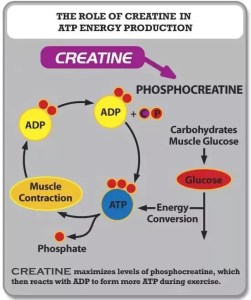
Unlike that toxic relationship, ATP is extremely critical to life and is the magical energy source for all living organisms. It is particularly critical in skeletal muscles, cardiac muscle and brain tissue. Creatine-phosphate (aka phosphocreatine) is what allows for the rapid cycling or conversion of ADP to ATP and ATP to ADP and so on.

Don’t feel sorry for that lonely phosphate molecule. It is about to be scooped off the single’s market by CREATINE in order to again form creatine phosphate so this crazy energy-filled drama fest can repeat it self. I mean, that’s why everyone tuned into that trial right.
Thanks for the Sleep Remedy but How can Creatine help me lose Weight?
Yes, I am getting to the how, I just like to start with the what and the why. Hopefully you can see the potential benefit for creatine supplementation since creatine is a major player in the energy transport system.
Supplementing with creatine maximizes the Ubers so those lonely phosphate groups can get scooped up and taken back to the energy show. In doing this, it has been demonstrated that creatine can boost forced output by 10%. If you get tired and fatigued at 25 push-ups or 25 squats then theoretically with creatine supplementation, you could do about 2.5-3 more push-ups or squats. The end result is muscle hypertrophy which is adding lean muscle mass to your body. Lean muscle mass makes up 70% of your basal metabolic rate which, when increased, could LEAD TO WEIGHT LOSS. There will be some weight gain initially in the form of water retention but this is due to water following creatine into the muscle cells. It is not harmful as it is intracellular. In the end the increased lean muscle mass will out weigh the increased water. The increased lean muscle mass will increase metabolism which will increase fat utilization and lead to fat mass loss thus net weight loss.

OK, But What Else Can It Do
Creatine has shown to:
How do I Use It
Creatine is found in many different types including creatine monophosphate, micronized creatine, creatine hydrochloride, creatine ethyl ester and many more. The cheapest, most studied and most effective form is creatine monophosphate. It is a very fine powder that you mix with water, protein shake, or juice. You just mix and drink.
To Load or Not To Load

You may have heard about loading vs not loading when starting creatine. What in the world does this mean? It’s far less dramatic than Shakespeare. It just means taking more creatine at first in order to get your muscles saturated with creatine faster. It is effective but not necessary. You will get the benefit of creatine if you only use a standard 5g daily dose. It just won’t be optimal for about 4 weeks. The downside of loading is it can possibly cause some muscle cramps and GI distress with bloating, gas, and diarrhea. I did choose to load and did not have much in the way of GI trouble or muscle cramps. I chose to load because I wanted to get to the maximum benefit quicker.
- Need Results Yesterday
- take 15-20g per day mixed completely into 10-12 oz of water, protein shake, or juice
- Do this for 5-6 days
- Switch to 5g per day
- Slow and Steady
- mix 5g daily into 8-10 oz of water, protein shake or juice.
Is It Safe?
For most, Absolutely. As stated, creatine is the most studied, and probably the safest, supplement on the market. It is naturally produced in our bodies and other than GI distress and muscle cramping during loading, I wasn’t able to find direct relatable adverse effects to creatine in healthy individuals who took normal doses. In fact, I came across this study from the International Society of Sports Nutrition which wholeheartedly supports the use of creatine and refutes any negative effects including GI upset, cramps, renal dysfunction, and liver disease.
“Creatine monohydrate supplementation is not only safe, but has been reported to have a number of therapeutic benefits in healthy and diseased populations ranging from infants to the elderly. There is no compelling scientific evidence that the short- or long-term use of creatine monohydrate (up to 30 g/day for 5 years) has any detrimental effects on otherwise healthy individuals or among clinical populations who may benefit from creatine supplementation.” ISSN 2017

Caution: There is a theoretical risk of worsening hypertension, worsening liver disease and worsening kidney disease if taking creatine supplements but the evidence is scant and weak. If you do have hypertension, kidney disease or liver disease, you should consult your doctor prior to starting creatine.


Products in this post and on this site are recommended based on my personal use, not my professional opinion, and individual results may vary. As an Amazon Affiliate, I could earn a commission on qualifying purchases.
Step Wise:
Try This:
Try adding strength training to your weight loss journey (start here)
Trying incorporating creatine into your fitness routine and see if you notice any benefits.
Remember creatine is not a miracle supplement as is not effective for everyone and will not grow muscles and melt fat simply by scooping and mixing into water.
As always, I sincerely hope you have enjoyed this article. Please like, subscribe and share if you have.
Dr. C.J. Wolinski
 Nutrition and Weight Loss
Leave a comment