



Knowing your body NEEDS a certain amount of energy is a good start to losing weight safely, effectively, and permanently. If you need some back ground information then check out this blog about BMR. (Don’t worry, it explains what BMR is) For those following along at home, I mentioned in this blog a variable that influences BMR; our calories consumed.
The Math is Simple. The Less Calories I Eat, The More Weight I Lose!

Well, yes and no. Everyone who has tried, with various degrees of effort, can probably tell you about a “wall” or “plateau” they hit after having weeks or maybe even months of success losing weight. A large component of this plateau is attributed to a subconscious return to bad habits while fully believing you are doing everything right. At the first signs of slowdown, I recommend going back to step one and counting/logging food and calories to ensure you are not over eating your target calories. The other possibility is somewhat controversial but plenty of literature supports it. You may have even heard of it…adaptive thermogenesis. No? How about metabolic slowing?, adaptive metabolism?, metabolic reset? or “starvation mode”. All of these terms essentially capture the same phenomenon. When you lose weight, your body adapts to less calories preparing itself essentially for a dooms day event where … you might not be as blessed to be in the company of food.
You Can’t Afford Not to Eat

When it comes to weight loss, getting enough of the right food is just as important as not eating too much of the wrong food. If calories were money then your body would be collecting income to pay off physiologic bills. Bills like running your brain, your heart, your lungs, liver, kidneys and muscles. When getting paid in excess, your body would be making Phat cash deposits in the bank. No, actually it’s calories stored in an adipose bank…or cell, I’m just a father of 3 teenagers and I can’t not tell dad jokes.
Seriously though, continuing in another suddenly forced metaphor, what if you started to not get paid as much? Well at first it wouldn’t be bad. We have reserves for situations just like this (adipose/fat cells). However, what if you had the world’s most conservative financial planner called the hypothalamus? Drastic drops in income pay which are significantly below what is required to “pay the bills” results in less spending not more utilization of reserves. Worse yet, there is a 401K called lean muscle which can not be tapped into without penalty. This less spending is what is known as “adaptive thermogenesis”. This is why we hit plateau’s even when we are strictly adhering to a low calorie diet. Especially when it is a radically low calorie diet.
Cleaning up the metaphor, when you consistently eat well below your BMR, it sends signals to your brain to not burn as much fat and results in an overall decreased BMR. This decrease in BMR happens for two reasons: 1. decreased lean muscle mass which we have learned is a fat furnace. 2. an adaptive slowing of metabolic processes throughout your body.
Step Wise Tips
- Educate yourself on your BMR ( if you are a patient of mine it is located on the right side of your InBody analysis)
- Download a Calorie counting app such as Lose It
- Educate yourself on Nutrition Labels
So How Much “Money” do I Need to Make Doctor Metaphor?

You’re getting kind of sassy with your questions but since I’m speaking in metaphors, I’ll allow it. If you have not done an InBody570 Composition Analysis I would recommend starting there. Of course you don’t need to know your exact body composition in order to estimate your BMR. The composition is an estimation as well but it’s more reliable than a formula.
Once you have your BMR, you will need to determine calories utilized by your physical activity, cumulatively made up by your Total Daily Energy Expenditure. The idea is to consume 500-1000 calories under your TDEE. (1-2 lbs loss per week) If this goal results in you not meeting your BMR, then you need to reduce your deficit by eating more or doing less. I would recommend eating healthier calories rather than not building muscle which will help you in the future. Let us recap on what four components make up our TDEE:
- BMR (70%)
- Non-Exercise Activity of Thermogenesis (15%)
- Thermogenic Effect of Food (10%)
- Exercise Activities of Thermogenesis (5%)
To figure out what your target calorie intake should be you need to take your TDEE and eat 25-30% less calories per day.
For me, when I calculated my optimum caloric intake using the TDEE formula and the 30% rule, I got 2582 calories * 30%= 775
2582-775= 1807
This 775 calories PER DAY deficit carried out over seven days results in a total weekly deficit of 5,425 calories which is 1.55 lbs per week or 6.2 lbs per month.
This is quite a lot of math which is why I like an app like Lose It. It does the math for you.
Looking from left to right. It shows I need 1714 calories each day to meet my goal weight. This is factoring in a consistent 1.5 lb weight loss per week. (far right). This is not far off from the calculated 1807 calories from above and is far easier on the brain cells. The middle picture depicts I didn’t meet my target caloric intake. It also breaks down my specific macronutrients (protein, carbs, fats) and where I could use some added energy.

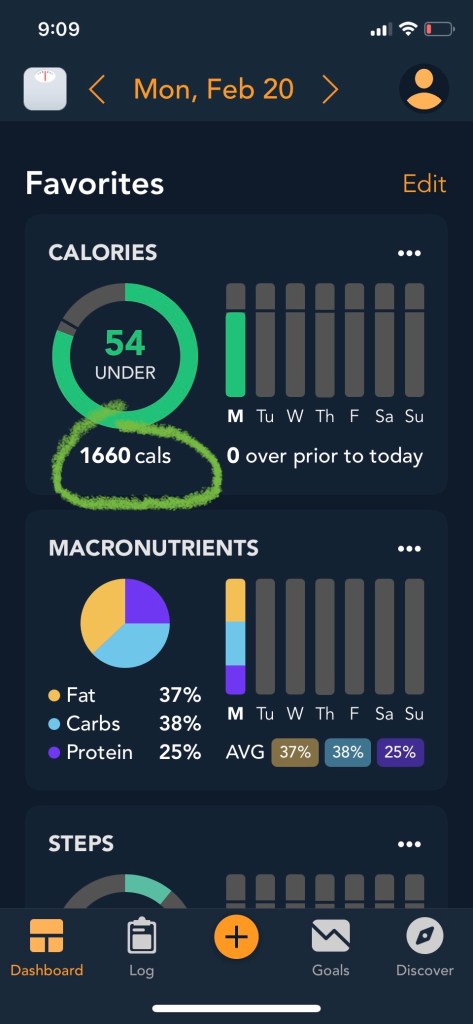

This target does not account for extra exercises or activities you are doing beyond what you put into the initial assessment. If you said you were sedentary then it calculated your target based on sedentary habits. This is fine because you have quite a bit of wiggle room because your BMR is 70% of your TDEE and your activity is only 20%. (you can’t out work a BAD DIET) If however, you are exercising 5-6 times a week and running 5 miles in 2 months, you will need to adjust your target calories. Otherwise, stick to the formula or app and hit the target. (you do loose weight a lot faster with good eating habits and exercise)
Step Wise Tips
- Try Calculating your own BMR and TDEE
- Try to calculate your optimum caloric intake for weight loss


Products in this post and on this site are recommended based on my personal use, not my professional opinion, and individual results may vary. As an Amazon Affiliate, I could earn a commission on qualifying purchases.
As always, I hope you enjoyed this blog and found it informative or at least entertaining. Please like, subscribe and share if you enjoyed the content of this post.
 Nutrition and Weight Loss
Leave a comment